
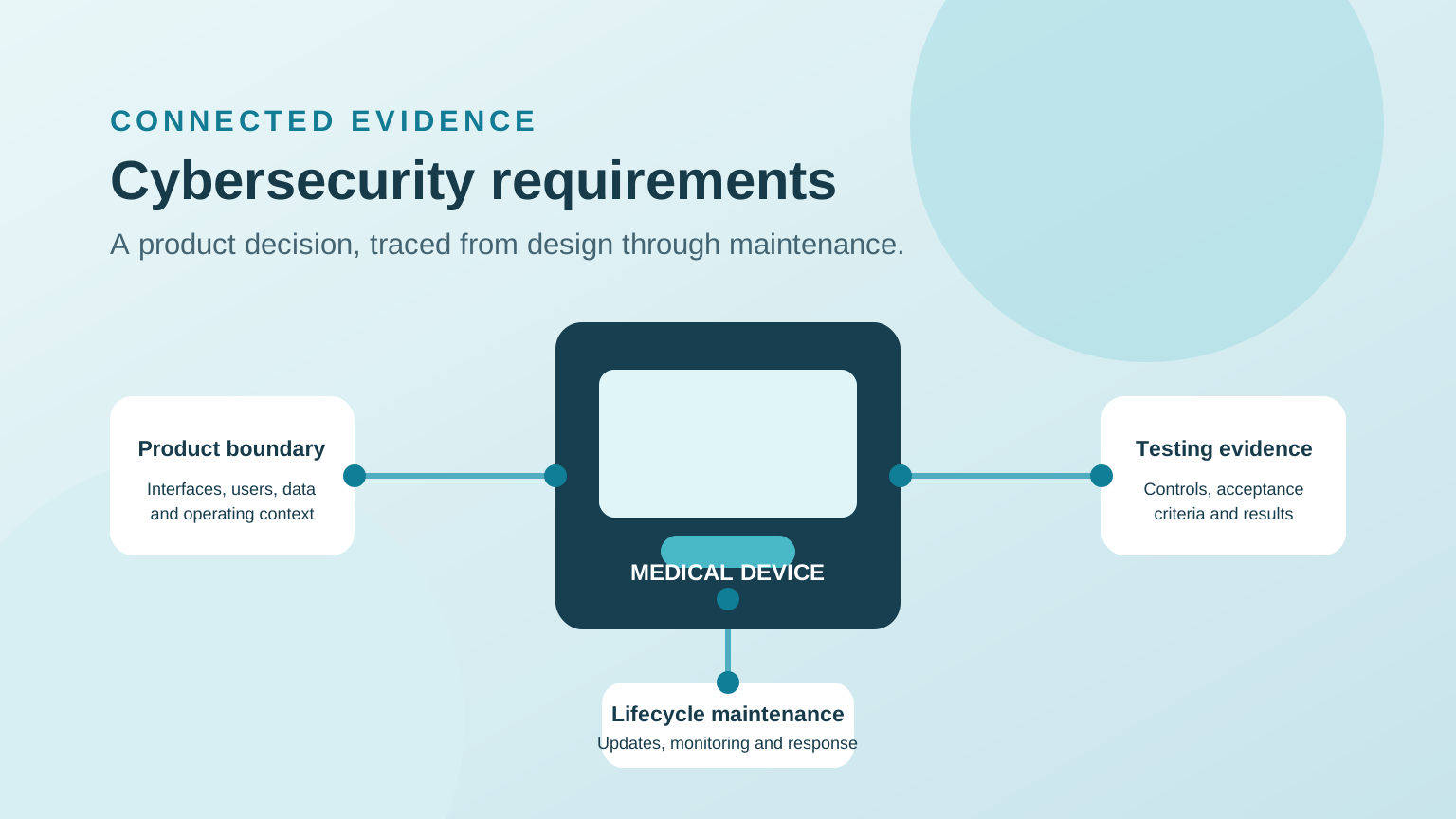
Medical device cybersecurity requirements are not satisfied by a last-minute checklist. They ask a manufacturer to show how cybersecurity is built into the actual device system, how the chosen controls are tested, and how the released product will remain supportable when new vulnerabilities or changes appear.
For a product team, the difficult part is rarely finding a list of familiar security terms. The difficult part is making the decisions connect. A reviewer needs to understand what the device and its related systems are, which cybersecurity scenarios matter, what the team chose to do about them, how it knows those measures work, and how the organization will respond after the product is in use.
The FDA's manufacturer cybersecurity resources explain that medical-device cybersecurity is part of safety and effectiveness. This guide translates that principle into a practical sequence for teams preparing a new device, a major change, or a premarket submission. It is not legal advice, and the right depth always depends on the product and its risk profile.
1. Establish whether section 524B applies
Section 524B of the Federal Food, Drug, and Cosmetic Act applies to premarket submissions for a device that meets the statutory definition of a cyber device. In plain terms, FDA describes a cyber device as one that includes software, firmware, or programmable logic and can connect to the internet. The rule reaches common submission paths, including 510(k), De Novo, PMA, Product Development Protocol, and HDE submissions.
For a qualifying device, the submission needs information showing three things: a plan to monitor, identify, and address postmarket vulnerabilities and exploits, including coordinated disclosure; processes and procedures that provide reasonable assurance the device and related systems are cybersecure, with updates and patches made available; and a software bill of materials. FDA's current premarket cybersecurity guidance adds detail about the design, labeling, and documentation FDA recommends for devices with cybersecurity risk.
That threshold question is worth answering early. It helps the team decide which product records, suppliers, testing activities, and postmarket responsibilities need to mature together. Waiting until the submission is assembled creates a predictable scramble, especially when component information, architecture decisions, or security test evidence were never connected to the quality system.
2. Define the whole medical device system
Cybersecurity requirements should begin with a clear system boundary, not an isolated box on an engineering diagram. A product may include embedded software, a clinician workstation, a mobile application, cloud services, service equipment, update paths, a hospital network, manufacturing systems, and third-party components. A device that does not connect directly to the internet can still have meaningful exposure through removable media, wireless links, ports, or service tools.
Document intended use, users, environments, interfaces, data flows, trust assumptions, and essential functions. This does not have to be an elaborate drawing. It has to be specific enough that engineering, quality, regulatory, clinical, and service teams are referring to the same product reality. Qualira's medical device threat-modeling guide explains how to use that view to identify credible scenarios rather than generic threats.
For example, remote service access might improve maintenance speed, but it also creates questions about identity, authorization, logging, software versions, recovery, and what happens if the pathway fails. Those questions belong in product decisions, not just in a test report. The more clearly the boundary is defined, the easier it is to identify the controls and evidence that actually apply.
3. Turn risks into security requirements and controls
FDA's guidance frames cybersecurity as a design responsibility. The useful next step is to trace each meaningful scenario from the device context to a security objective, a chosen control, and the evidence that will show whether the control works. A team might evaluate authentication, authorization, cryptography, code and data integrity, confidentiality, event detection and logging, recovery, and the ability to update or patch. The right mix depends on the system and the realistic consequences of failure.
A control is not a complete answer because it has a familiar name. Password-based access, encryption, audit logging, or a signed update mechanism must be appropriate for the device and implemented in the way the system requires. A control should have a defined purpose, acceptance criteria, an owner, and a link to the risks it helps reduce. The cybersecurity risk-assessment guide helps distinguish a technical finding from the device-specific consequence that makes it important.
Teams often get stuck by treating the cybersecurity record as separate from design controls and risk management. A better approach is to make the connection visible where work is already being controlled: product requirements, design reviews, supplier decisions, verification plans, configuration records, and change assessments. This is how an evidence package stays useful after the first submission, rather than becoming a one-time binder.
4. Build testing evidence that answers the real question
Testing should show that the selected controls work for the released product and its intended environment. That can include requirements testing, vulnerability assessment, penetration testing, code analysis, configuration review, interface testing, recovery testing, and update verification. Each method answers a different question. A vulnerability scan can identify known issues, while penetration testing explores whether an authorized attack path is realistic and consequential in the actual configuration.
The evidence is stronger when the test scope is explicit. Record the system versions, interfaces, assumptions, configurations, limits, test conditions, results, and follow-up actions. If a finding leads to a change, the team should be able to see the updated risk decision, design change, verification, and released configuration. That is what turns a report into a maintainable product record.
Use the medical device cybersecurity testing guide to plan the broader testing strategy, and the penetration-testing guide when an authorized adversarial assessment can add useful evidence. Neither replaces the need to understand the product's boundary and lifecycle responsibilities.
5. Treat the SBOM as an operating record, not a filing attachment
For cyber devices, an SBOM is a required part of the section 524B submission information. But its business value comes after submission. A current component record helps a manufacturer answer the first urgent question when a vulnerability is disclosed: could this component be present in the released product or a related system?
That is only the first question. An SBOM cannot decide whether the vulnerable capability is enabled, reachable, protected by other controls, or capable of affecting safe and effective use. It needs to work with the system description, threat model, risk assessment, configuration history, and vulnerability-response process. The FDA SBOM guide explains how to make that record useful when a new security signal arrives.
Keep versions, suppliers, relevant dependencies, and released configurations traceable. When a supplier changes a component or an update is planned, the organization should be able to assess the effect without reconstructing its own product history. That is a practical quality-system advantage, not paperwork for its own sake.
A practical requirements review before a major milestone
Before a design freeze, submission, customer assessment, or major software release, bring the right functions together for a focused review. The goal is not to create a second quality system. It is to identify the few decisions that could cause late rework if they remain disconnected. A short, evidence-led review is often more useful than asking each function to produce an isolated cybersecurity document.
Start with the product picture. Confirm the intended use, users, interfaces, connected services, support tools, software versions, and relevant operating environments. Ask which parts can affect confidentiality, integrity, availability, safety, essential performance, or the ability to maintain the device. Then test whether the current system description and product architecture tell the same story. Where they differ, the team has found a useful question to resolve before it becomes a review finding.
Next, choose the scenarios that deserve the closest attention. These might include unauthorized remote access, compromised service credentials, a vulnerable third-party library, an interrupted update, altered clinical data, a failed connection to a cloud service, or an unavailable essential function. The point is not to speculate about every theoretical attack. It is to consider credible paths in the actual product context and decide what evidence should be available for each important path.
For each selected scenario, make four links visible: the risk or product concern, the security requirement or control, the verification method, and the released configuration it applies to. If the team cannot make one of those links, it does not necessarily mean the device is unsafe. It means the evidence is incomplete or difficult to use, which is an early warning worth addressing. Qualira's cybersecurity documentation guide explains how to keep these records coherent without turning them into a paperwork exercise.
It also helps to separate a known gap from an unresolved decision. A known gap might be a missing test result or a component version that has not been captured. An unresolved decision might concern the best authentication approach for a service workflow or the safety implications of an update. Treating both as the same kind of task creates confusion. The first needs an owner and completion path. The second needs the right people, facts, and decision criteria before the team can responsibly close it.
Finally, look beyond the submission. Name the signals that should trigger a reassessment: a component vulnerability, supplier change, new interface, software release, change in intended environment, customer security requirement, complaint trend, or field issue. Decide who receives that signal, who coordinates the assessment, what facts are needed, and how a decision is recorded. This turns a requirement into an operating capability that remains useful through the life of the device.
6. Make postmarket response part of the product plan
A product is not finished when its first cybersecurity evidence package is complete. The manufacturer needs a repeatable way to receive and assess vulnerability information, decide whether the product is affected, evaluate the device-specific impact, choose an action, verify a change, and communicate responsibly when appropriate. FDA's postmarket cybersecurity guidance describes this lifecycle expectation.
Ownership matters here. One person can coordinate the response, but decisions often need input from product security, software or systems engineering, quality, regulatory, clinical, service, and customer-facing teams. A useful process gives those functions a shared fact pattern and a clear decision record. Qualira's vulnerability-management guide sets out the cycle from intake through verification and communication.
Test the process with a realistic scenario before a real incident forces the issue. Can the team identify the released configuration, determine whether a reported vulnerability reaches the device, assess the consequence, decide on proportionate action, verify the result, and keep a record that explains the decision? If the answer is no, that gap is the next requirement to address.
How Qualira helps
Qualira helps medical-device teams connect cybersecurity requirements to the product decisions that determine a credible submission and a supportable lifecycle. That includes system boundaries, threat modeling, risk management, quality procedures, testing evidence, software-component records, and postmarket response. Explore medical device cybersecurity consulting or talk with Qualira's team when the work needs senior support across technical, quality, clinical, and regulatory decisions.
Frequently asked questions
What are the FDA cybersecurity requirements for a medical device?
For a device that meets the statutory definition of a cyber device, section 524B requires premarket submission information showing a plan for postmarket vulnerabilities, processes that provide reasonable assurance of cybersecurity and updates or patches, and a software bill of materials. FDA guidance also explains the device-level design, testing, labeling, and documentation it recommends for devices with cybersecurity risk.
Does every medical device need an SBOM?
An SBOM is a statutory submission requirement for cyber devices under section 524B. Other devices may still benefit from a component record when software or programmable logic affects the product, but the appropriate documentation depends on the device, its interfaces, and its risk profile.
Is penetration testing enough for medical device cybersecurity?
No. Penetration testing can provide valuable evidence about an authorized scope, but it does not establish the system boundary, security requirements, risk decisions, traceability, or postmarket process on its own. It should support a connected evidence package.
When should a team start medical device cybersecurity work?
Start when intended use, interfaces, users, data flows, and major architecture choices are being defined. That timing gives the team room to choose proportionate controls and verify them before a submission or release makes changes costly.


