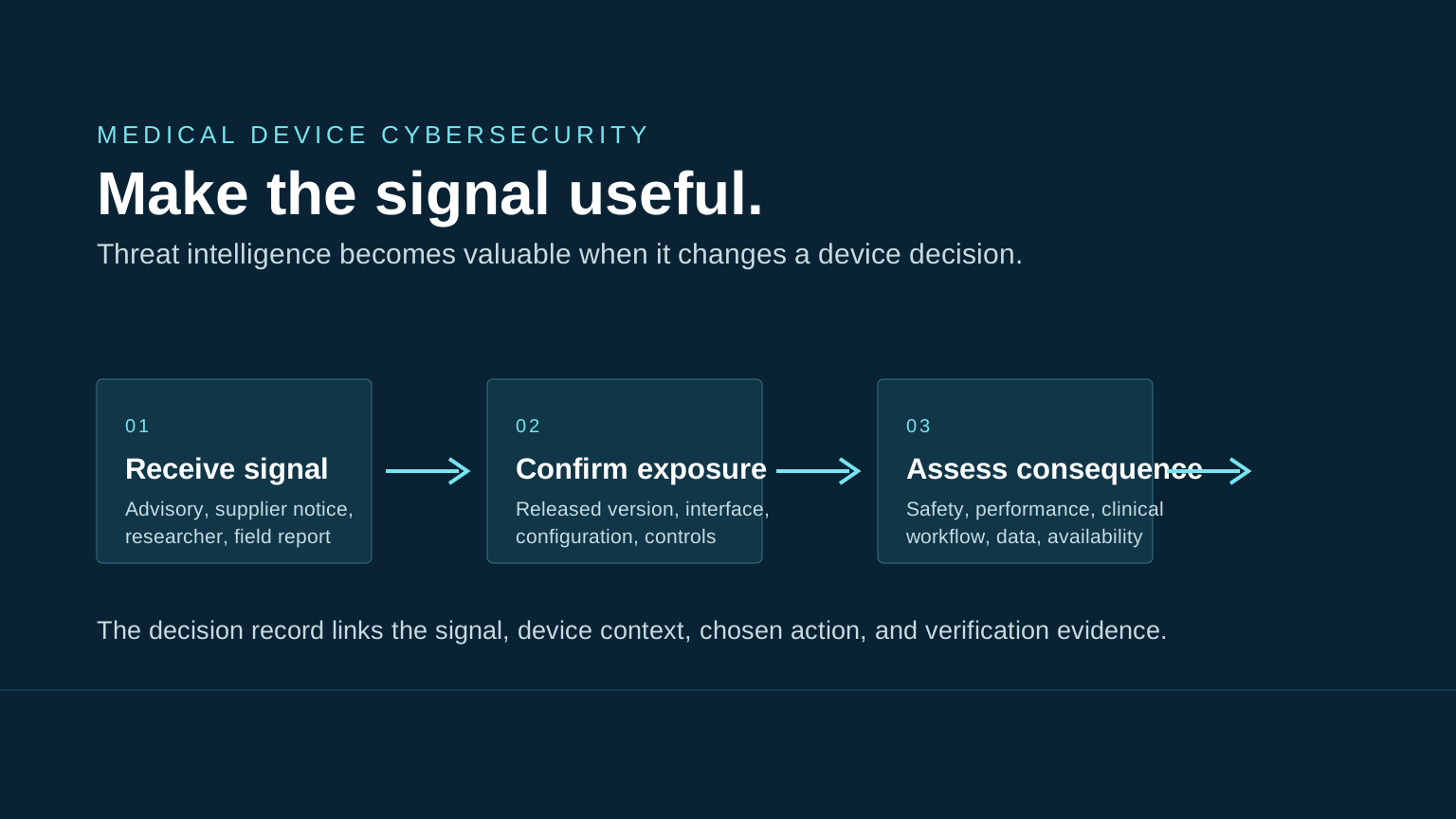
Medical device threat intelligence is the disciplined use of security information to make a better product decision. A new advisory, supplier notice, researcher report, or field observation is not automatically a device emergency. It becomes useful when a team can connect it to the released product, the use environment, the controls already in place, and the possible consequence to safe and effective use.
Connected devices do not stand still after release. Components change, researchers publish findings, attackers adapt their methods, suppliers issue notices, and healthcare environments evolve. The difficult part is not finding more information. It is deciding which signals deserve attention, who should assess them, and how to act without creating a rushed change that harms the product, the clinical workflow, or the evidence trail.
FDA describes cybersecurity as a lifecycle responsibility for device manufacturers. Its medical device cybersecurity resources emphasize identifying risks and hazards, assessing vulnerabilities, and developing appropriate remediation. A mature intelligence practice makes those activities repeatable. It gives the team a way to move from outside information to a device-specific decision before a situation becomes costly or confusing.
Start With a Signal That Can Be Investigated
Threat intelligence can arrive through a supplier bulletin, a coordinated disclosure, a government alert, a security researcher, an internal test, a customer, or a service team. Each source brings different detail and urgency. A credible report might name a component, product version, attack method, or affected interface. Another signal may be only a broad headline about a technology used somewhere in the organization. The intake process needs to preserve the facts without assuming either that every report is irrelevant or that every report proves patient risk.
Record the source, date, affected product or component, available technical detail, and the reason the signal may matter. Then assign an accountable owner who can coordinate engineering, quality, regulatory, clinical, service, and security input. That owner is not expected to answer every question alone. Their job is to make the next decision visible, keep the assessment moving, and ensure the final conclusion can be found later.
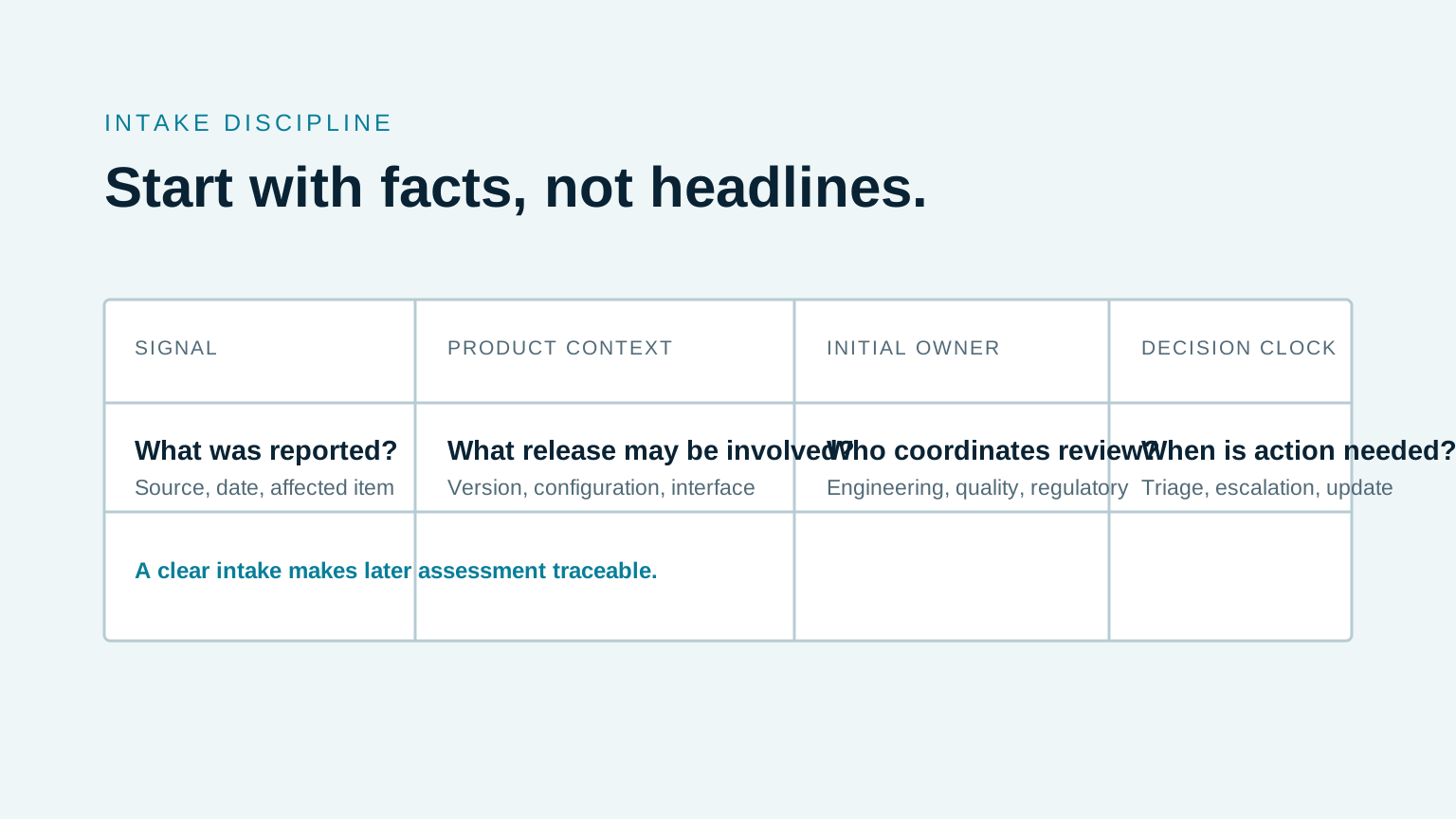
A clear intake also separates monitoring from escalation. A general industry report may belong in a watch list. A report that names a released component, a reachable interface, or an exploit affecting the use environment may require immediate cross-functional review. The exact trigger should fit the product, but the team should never have to invent its response process while a credible signal is already waiting.
Confirm the Product Context Before You Judge the Risk
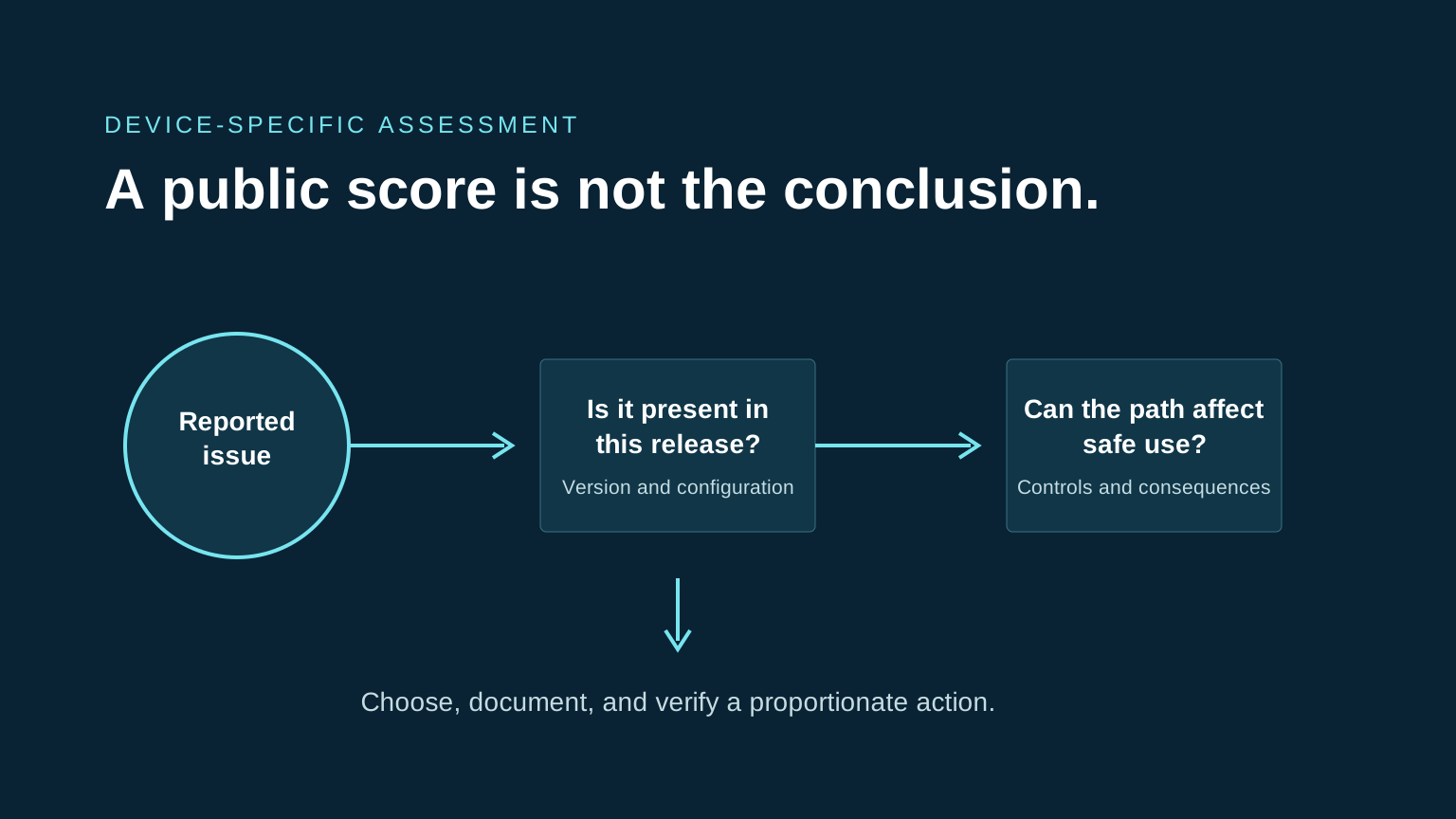
The first practical question is not “How severe is the public score?” It is “Is this actually present in the device we released?” A component can exist in a development environment but not in a fielded version. A vulnerable feature can be disabled. An issue may require a network path, credential, physical port, or connected service that the product does not expose. Conversely, a modest-looking software issue may deserve urgent attention if it could change a therapy setting, delay an alarm, corrupt a diagnostic result, or interrupt an essential function.
That is why release and configuration context matter. A useful assessment identifies the model, software or firmware version, component versions, relevant interfaces, deployment pattern, customer configuration, and compensating controls. A current software bill of materials helps a team identify where a component may be present. It does not decide exposure or consequence by itself, but it makes the investigation faster and less dependent on memory.
FDA’s postmarket cybersecurity guidance recommends analyzing the impact of a cybersecurity signal across a manufacturer’s portfolio and within specific components of a device. That horizontal and product-specific view prevents a narrow fix from missing a related release or an adjacent product. It also helps the team communicate accurately with customers and internal stakeholders rather than treating a report as a generic enterprise IT issue.
Assess the Whole Path to a Device Consequence
Once the product context is clear, map the path from the reported issue to the possible consequence. What access would an attacker need? Would they need physical proximity, a trusted account, a hospital-network position, a service tool, or access to a connected cloud service? Which controls limit the path? Could the outcome affect confidentiality, integrity, availability, essential performance, patient safety, clinician workflow, or the organization’s ability to service the device?
This work connects naturally to the threat model and cybersecurity risk assessment. The threat model provides the relevant assets, trust boundaries, and plausible scenarios. The risk assessment explains the product-specific significance and residual risk. Threat intelligence then supplies new information that may challenge an assumption already present in those records.
Government alerts can be valuable input, but they need the same contextual review. CISA’s cybersecurity advisories can provide technical details, indicators, and mitigation recommendations for active or significant threats. Those details may inform a medical-device team’s investigation, while the product team still has to determine what the information means for its own architecture, release, users, and clinical environment.
Choose a Proportionate Action
The right response is not always a software update. Depending on the evidence, the team may decide that no affected product is in the field, continue monitoring, adjust a configuration, introduce a compensating control, issue service guidance, change a supplier process, plan a controlled correction, or communicate with customers and regulators. The action should match both the device-specific consequence and the confidence in the available facts.
For a connected device, an update can itself introduce risk. A change may affect intended function, interoperability, validation, service procedures, user workflow, or the ability to recover from an interruption. The team should evaluate the correction in the same product context used for the original assessment. That keeps the response from becoming a security-only decision that creates a new safety or quality problem beside it.
Where a vulnerability response is needed, connect the work to the quality system and change controls. The vulnerability-management guide explains the operating cycle from intake through assessment, remediation, verification, and communication. Threat intelligence makes that cycle more proactive by giving the team a structured way to recognize a relevant signal before it turns into a field issue.
Set Escalation Thresholds Before an Urgent Report Arrives
Escalation should be based on the combination of product relevance, credible exploitation conditions, and potential consequence, not on a single public label. A team can define examples in advance: a report involving a released and reachable component, an issue that could affect an essential function, a credible disclosure with evidence of active exploitation, or a supplier notice that changes the support status of a critical dependency. The exact threshold will differ between a stand-alone device, a home-use connected product, and a hospital-installed system.
The goal is not to automate a safety judgment. It is to avoid losing time deciding who needs to be in the room. Clear triggers let the right specialists begin a structured assessment, while lower-confidence signals can be documented, monitored, and reviewed without pulling an entire program into an unnecessary emergency. A proportionate process protects attention as well as the product.
Verify the Result and Preserve the Rationale
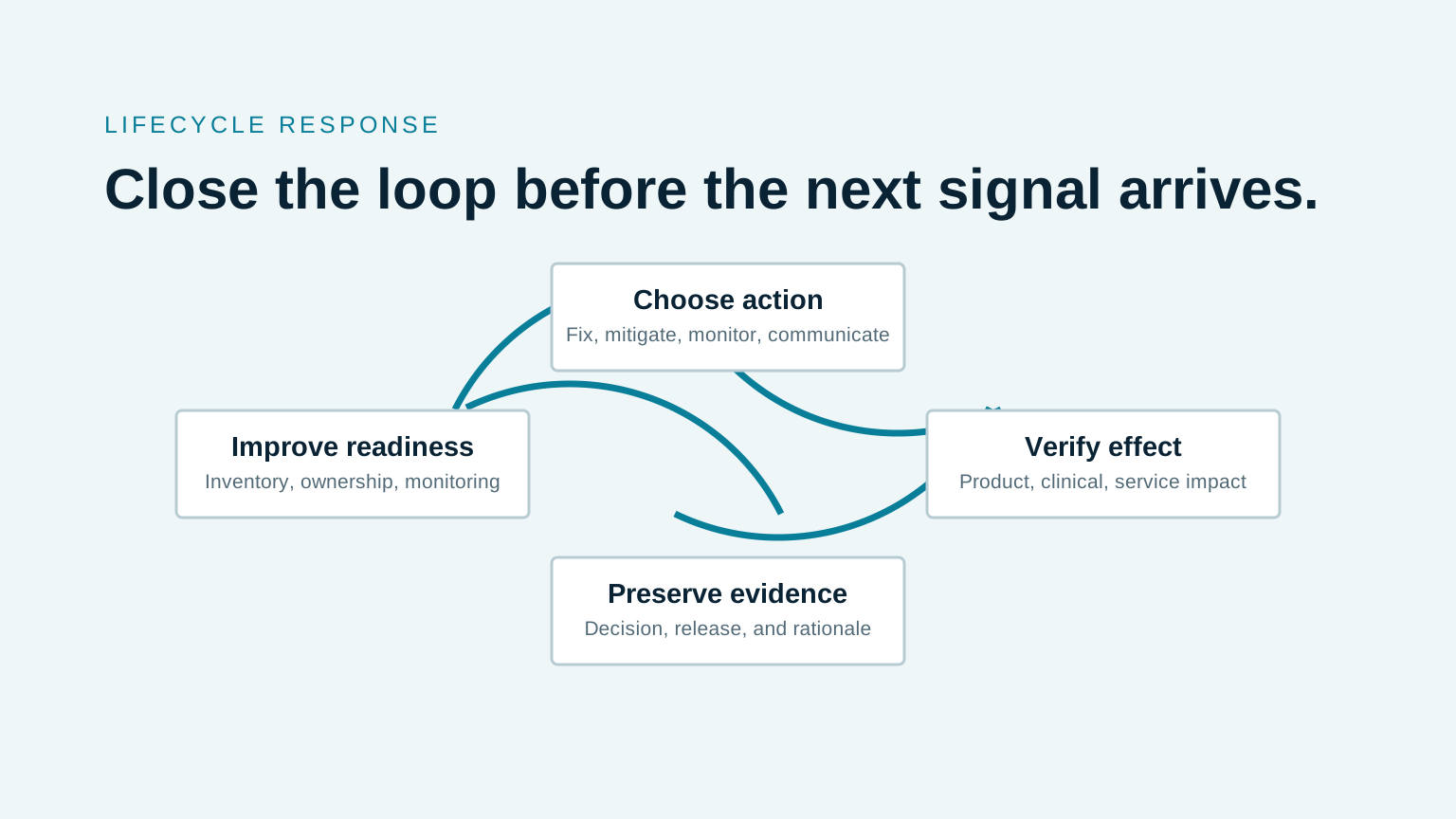
A response is not complete because a ticket has been closed. The record should show what signal was assessed, which product versions and configurations were considered, who participated, which assumptions mattered, what action was selected, how the action was verified, and why the residual risk is acceptable. That evidence is useful when the product changes again, a customer asks a question, an auditor reviews the process, or a similar report arrives months later.
Verification needs to match the change. A software correction may need functional, cybersecurity, interoperability, usability, and release checks. A mitigation in the use environment may need confirmation that the organization can actually apply and sustain it. A decision to monitor may need an owner, review date, and criteria that trigger reconsideration. FDA’s postmarket cybersecurity guidance frames that work around ongoing monitoring, assessment, and response. These details turn a reasonable one-time conclusion into a manageable lifecycle practice.
Build a Small, Reliable Intelligence Routine
Most teams do not need a giant threat-intelligence operation. They need a disciplined routine that matches their product and resources. Define the sources that matter, the person or group that reviews incoming signals, the information needed for triage, the conditions that trigger escalation, and the controlled records that hold the final decision. Review the routine after real cases, supplier changes, a significant release, or a new connected feature so it remains practical.
Good intelligence also depends on relationships. Suppliers should provide a route for security notices. Service and support teams should know how to recognize and escalate unusual reports. Engineering should be able to identify the relevant release and configuration. Quality and regulatory teams should understand where the decision record belongs. Clinical and product leaders should help evaluate how a proposed action affects intended use. When those contributors share a single path, a signal can be handled with focus instead of a scramble.
How Qualira Helps
Qualira helps medical-device teams connect security signals to the decisions that matter: intended use, architecture, threat modeling, risk management, quality records, verification, submissions, and post-market support. The goal is a proportionate process that produces useful evidence and clearer choices, rather than another isolated cybersecurity document. Explore medical device cybersecurity consulting or talk to an expert when a new signal, release, or field question needs a coherent path forward.
Frequently asked questions
What is medical device threat intelligence?
Medical device threat intelligence is relevant, timely information about threats, vulnerabilities, attack methods, or exposures that may affect a specific device or its environment. Its value comes from connecting the signal to the released product, its use environment, and a documented decision.
Is threat intelligence the same as vulnerability management?
No. Threat intelligence brings information that may require attention. Vulnerability management is the controlled process of determining whether that information affects a product, evaluating the device-specific risk, choosing an action, verifying it, and communicating when appropriate.
Which threat intelligence sources should a manufacturer monitor?
The right sources depend on the product, but commonly include component and supplier notices, government advisories, coordinated disclosures, trusted security research, customer reports, and internal testing. The important part is having a clear path to triage credible signals rather than attempting to monitor every source equally.
How quickly must a manufacturer act on a cybersecurity signal?
The response should match the evidence and potential consequence. A credible report affecting a released, reachable function may need prompt escalation. A general report with no confirmed product relevance may first need structured investigation. In either case, the manufacturer should record the assessment, owner, timing, and rationale.


