Medical device cybersecurity supply chain work is not a supplier questionnaire filed at purchase. It is the practical discipline of knowing what is in the released product, who can change it, how the team will hear about a concern, and how it will decide whether the concern affects safe and effective use.
A connected device is rarely built by one team with one codebase and one operating environment. It may rely on commercial software, open-source packages, a cloud platform, a contract manufacturer, a wireless module, a service tool, a mobile application, and suppliers who each maintain part of the technical picture. Those relationships can create valuable capability. They can also create uncertainty when a component changes, support ends, or a vulnerability report arrives.
The right goal is not to eliminate every dependency or demand identical evidence from every supplier. It is to establish a proportionate, usable process that follows the product lifecycle. FDA's cybersecurity resources for manufacturers explain that device teams need to maintain processes for addressing vulnerabilities and making updates or patches available when appropriate. A supply chain process gives those obligations a workable starting point.
Start With the Released Product, Not the Supplier List
Supplier management becomes useful when it begins with the actual device system. Before collecting documents, define the released configuration: device hardware and firmware, installed software, mobile or desktop applications, cloud services, interfaces, service tools, and the external systems that affect the device's intended operation. Identify the versions and configurations that are in scope, not only product names.
This product view matters because a supplier notice rarely answers the medical-device question on its own. A notice may name a library, operating system, chipset, cloud service, or hardware component. The manufacturer still needs to determine whether that item is in a particular product version, whether the affected function is enabled or reachable, whether compensating controls exist, and whether exploitation could affect safety, essential performance, data, availability, or clinical workflow.
That is why FDA's post-market guidance distinguishes the existence of a vulnerability from the risk it creates for a device. The guidance recommends a structured assessment that considers exploitability, potential patient harm, compensating controls, and mitigation. A supplier inventory helps a team find the right product question quickly. It does not replace the product-specific judgment that follows.

Make Supplier Decisions Part of Product Evidence
Different suppliers create different risks and different evidence needs. A contract manufacturer that controls a production-stage configuration is not the same as an open-source dependency used in a non-critical tool. A cloud provider that supports a device-facing function is not the same as a disposable development utility. Treating every relationship as identical creates paperwork without clarity. Treating every relationship as someone else's problem creates a blind spot.
For material components and services, teams should be able to answer a few practical questions. What does this supplier or component do in the device system? Which released versions use it? Who owns the technical relationship? How will the manufacturer receive a security notice or change notification? What support, update, or end-of-life commitments apply? Which product records need to be revisited if it changes? These answers can live in controlled records, supplier files, architecture views, configuration records, or a product-specific inventory. The format matters less than the ability to use it under time pressure.
Supplier agreements can support this work, but they do not make the manufacturer's analysis optional. FDA notes that the manufacturer chooses to use off-the-shelf software and remains responsible for its security and safe, effective performance in the medical-device context. A supplier may provide a patch, a component list, or a security advisory. The manufacturer still has to determine what that means for the device it released.

Use an SBOM as an Investigation Tool, Not a Finish Line
A software bill of materials can make component questions much faster. It can help a team determine whether a reported package, library, operating system, or commercial component may be present in a specific release. For cyber devices subject to section 524B, FDA requires an SBOM in the premarket submission, including commercial, open-source, and off-the-shelf software components. That makes the inventory an important part of the evidence package.
But a list cannot answer whether a vulnerability creates device risk. It may not show whether the affected code is active, whether the interface is exposed, whether authentication or segmentation limits access, which released configurations are affected, or what patient or clinical consequence could result. FDA's current resources make the same point about vulnerability assessment and VEX information: useful data can inform the analysis, but it does not replace the device-level assessment.
A mature process therefore connects the SBOM to the records around it. Link the inventory to the released configuration, system architecture, threat model, risk decision, supplier contact path, and verification evidence. When a vulnerability arrives, the team should be able to move from component identification to an owned decision, rather than opening a broad investigation with no clear route to closure. Qualira®'s FDA SBOM guide explains how an inventory can support that traceability.
Plan for Changes Before They Become an Incident
The most effective supply chain practice is proactive. A component change, expiring certificate, new cloud dependency, revised service tool, supplier end-of-life notice, or firmware update can change the cybersecurity posture before an external vulnerability alert arrives. The question is whether the organization has a clear trigger for reviewing the impact.
Build that trigger into ordinary product controls. Procurement should know when a material component needs technical and quality input. Engineering should know when an interface, dependency, or configuration change needs security review. Quality should know how the assessment connects to design change, verification, release, and corrective-action processes. Service teams should know which field configurations or update routes matter. Regulatory teams should be able to see whether the change affects the evidence planned for a submission or the information already provided to a reviewer.
This is not a demand for a separate cybersecurity bureaucracy. It is a way to make normal product change decisions more complete. A simple change review can ask: what product versions are affected, which system boundary or security assumption changed, whether the threat model or risk rationale needs revision, what testing is needed, and how the released configuration will be updated. The answer should be documented at the same level of discipline as the product decision itself.

Turn a Vulnerability Notice Into a Repeatable Response
When a component or supplier notice arrives, speed matters, but speed without a structured process can produce an unreliable conclusion. Start by recording the signal and assigning an owner. Establish the reported component, versions, affected functions, available vendor information, and urgency. Then determine whether the component appears in any released or supported product configuration.
If the device may be affected, assess the device-specific context. Is the function enabled? Can an attacker realistically reach it through the device, related system, or use environment? Does the existing architecture, authentication, segmentation, monitoring, or physical access limit exposure? What could happen if the vulnerability were exploited? Does the conclusion differ across product versions, customer configurations, or connected services? The answer should be more specific than a generic severity score.
Next, select and document an action. A patch, configuration change, compensating control, customer communication, monitoring decision, or justified decision not to change may each be appropriate in different circumstances. The action needs an owner, a verification approach, and clear criteria for closure. Qualira®'s vulnerability-management guide describes the complete loop from signal intake through verified response.
Keep the Evidence Useful for a Submission and for Life After Launch
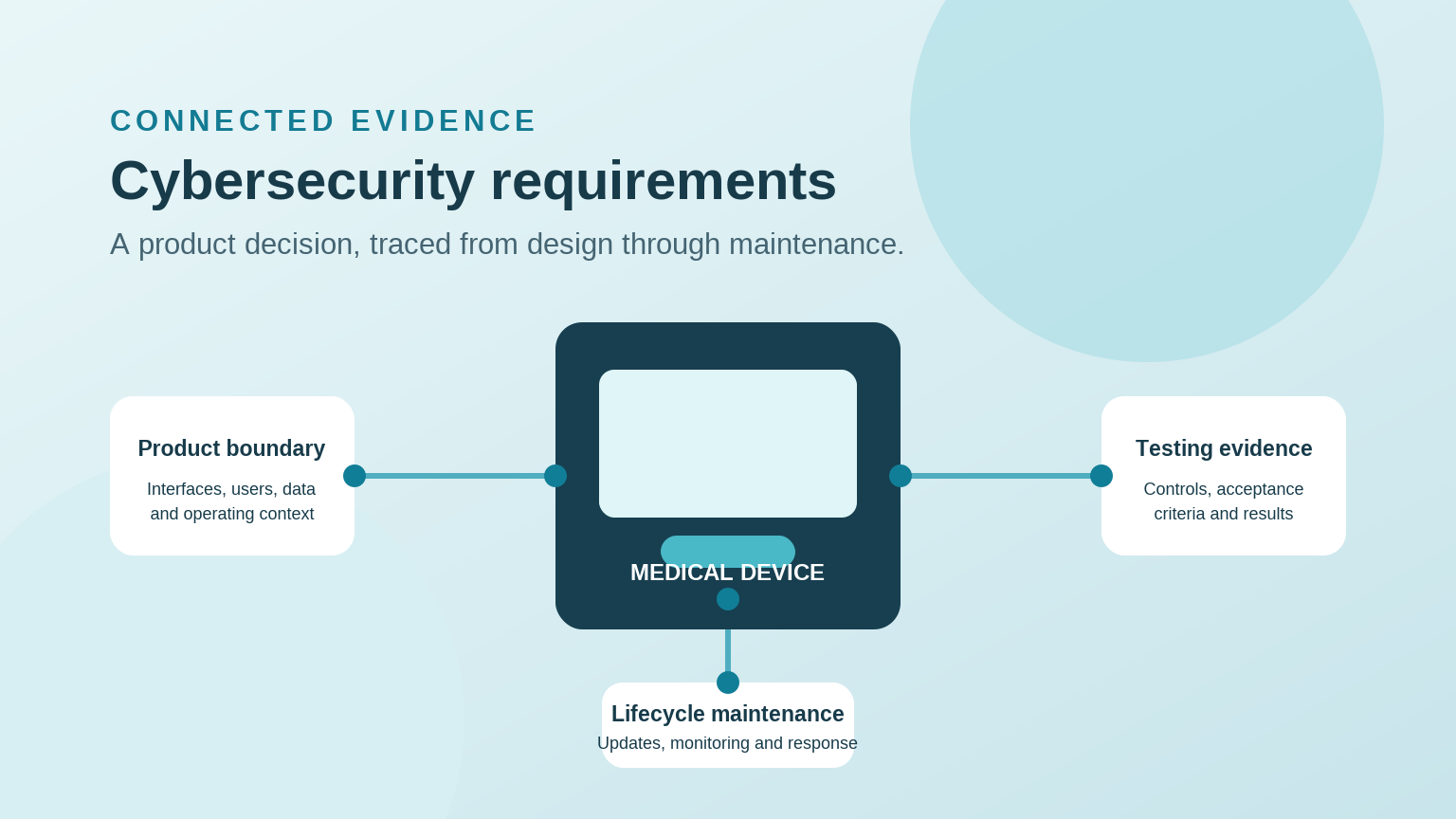
Supply chain cybersecurity records should serve more than one milestone. They should help a team organize a premarket submission, respond to customer diligence, make a release decision, investigate a vulnerability, and support a product after launch. The strongest evidence is connected rather than duplicated: the same accurate product boundary informs the threat model, the component inventory, the risk assessment, the test scope, and the post-market plan.
FDA's February 2026 premarket cybersecurity guidance covers design, labeling, and the documentation FDA recommends in submissions for devices with cybersecurity risk. Its companion manufacturer resource explains that section 524B reaches post-market vulnerability plans, processes and procedures to provide reasonable assurance of cybersecurity, updates and patches, and an SBOM for applicable cyber devices. A supplier and component process is one practical way to make those commitments operational rather than aspirational.
Do not confuse a standard, supplier attestation, or successful test with a blanket regulatory outcome. Each can contribute useful evidence within a defined scope. The decision remains device-specific. The right question is whether the manufacturer can show how it selected components and suppliers, understood their role in the product, assessed meaningful changes, and maintained the ability to respond as the product and its environment evolve.
How Qualira® Helps
Qualira® helps medical-device teams connect supplier, component, and cybersecurity decisions to the rest of the product evidence. That includes system boundaries, risk management, quality processes, verification, configuration control, regulatory planning, and post-market response. The goal is a process that helps the team make better decisions when a supplier change or vulnerability matters, not another disconnected binder.
Explore medical device cybersecurity consulting and medical device quality consulting, or talk with Qualira®'s team about the product decision that needs a clearer evidence path.
Frequently asked questions
What is medical device cybersecurity supply chain management?
It is the set of product and quality practices that helps a manufacturer understand the software, hardware, services, and suppliers that affect a device, then act when a component, vulnerability, or supplier change creates a meaningful cybersecurity question. It should connect procurement, architecture, risk, verification, released configuration, and post-market response.
Does an SBOM solve medical device supply chain cybersecurity?
No. An SBOM can help identify whether a software component may be present in a released product, but it does not show whether the component is enabled, reachable, or consequential in that device. It also does not replace supplier oversight, device-specific risk assessment, change control, or verification.
What cybersecurity information should a device team request from suppliers?
The useful information depends on the component and its role. Teams commonly need a clear version and configuration record, security-contact and notice path, support and update expectations, known limitations, component inventory information, and a way to assess whether a supplier change affects the released device. The manufacturer remains responsible for evaluating the product-specific consequence.
When should supply chain cybersecurity be reviewed?
Review it when selecting a supplier or component, defining the product architecture, preparing a release, receiving a vulnerability or supplier notice, changing a component or service, and planning a post-market update. The review should be proportionate to the device, interface, intended use, and potential effect on safety or essential performance.